Saturday, July 7, 2012

Paramount Summer Classic Film Series: North by Northwest and Strangers on a Train

The final installment of Hitchcock week at the Paramount was the pairing of North by Northwest and Strangers on a Train.  This was a fun pair of films to see together.  North by Northwest (1959) screened first.  In the film, Cary Grant plays Roger O. Thornhill, a New York advertising executive.  One day, he is kidnapped by foreign spies who have mistaken him for a man named George Kaplan.  They take him to a mansion, presumably owned by one of the spies.  Thornhill insists that he is not George Kaplan and does not have any of the information the spies are looking for.  For his insolence, they force him to drink entirely too much whiskey and then put him behind the wheel of a car.  He survives the drive down a mountain (barely), but is taken into police custody for drunk driving.  Due to his drunken state, the police do not believe his story about the kidnappers.  So, Thornhill decides to take matters into his own hands and find Kaplan himself.  His quest takes him to various locales across the country, including Chicago, Indiana, and Mount Rushmore.  Thornhill eventually learns that there is no George Kaplan and that he has found himself in the midst of a complex government operation.

Cary Grant's portrayal of Roger Thornhill is great.  He's a selfish, superficial, and he drinks too much, but Grant still manages to make him likable enough that we care what happens to him when he gets kidnapped, and does so in the first few minutes of the film.  His character changes drastically in the course of the film.  For more on that, here's an excerpt from a paper I wrote on this movie for my graduate film studies class.


With the introduction of Eve Kendall (Eva Marie Saint), Thornhill’s character begins to change.  Initially, she seems to be exactly the right woman for Thornhill, in that she is a superficial and noncommittal as he.  The two bond instantaneously and there seems to be a real affection between them. Based on what has been established about Thornhill, it would seem out of character for him to become attached to a woman.  Yet he has, heightening his, and the audience’s, sense of surprise and betrayal at her involvement in the attempt on his life.  The introduction of Eve Kendall functions to help Roger Thornhill mature, and his allowing himself to genuinely feel for her is the first sign of this maturation in the film.  We continue to see him grow as he (and we) learn more about her and their relationship changes.  For example, after he discovers that she was involved in the attempt on his life, he has difficulty trusting her.  When he sees her again in her hotel room, she runs to him, relieved that he is still alive, and his hands encircle her head, in the same way as they did earlier on the train.  Only this time, he stops short of touching her, indicating that the trust formed when they initially met is gone.  Thornhill has learned from his experiences in a way that someone who lives as superficially as the opening of the film suggests he does would be unlikely to do.  The change in Thornhill’s character culminates with his placing himself at risk for the woman he loves and ultimately marrying her.  Again, these are actions that the Thornhill of the beginning of the film is unlikely to take.  The man who once shied away from commitment (it is revealed early in the film that Thornhill has been married, and divorced, twice) is now willing to fully commit himself to another person, even to the point of potentially losing his own life.  Watching these changes in Thornhill evokes a sense of joy in the viewer; we are glad that he has survived his ordeal, that he has at last found true love, and that he has grown enough as a person to recognize and accept love rather than run away from it.

Bernard Hermann's score is fantastic as well.  Here's another excerpt from the paper about how sound functions in the film.

The opening theme is fast-paced, setting an appropriate tone for the big city setting of the film’s opening scene.  Hermann used shifting rhythms in the theme to suggest the chaos which is going to ensue as the film progresses.  The opening theme is repeated several times, providing an aural backdrop for several of the most exciting scenes in the film.  In the kidnapping scene, ominous music which echoes the opening theme alerts the viewer that a threat has been introduced; the mood of the music makes the audience feel threatened and uncomfortable.  During the chase scene, when Thornhill drunkenly takes the wheel of the car, the repetition of the opening theme builds tension and excitement, helping to keep viewers on the edge of their seats.  It plays again in the cafe scene at Mount Rushmore, as Thornhill waits for Eve and VanDamm to arrive.  This time, however, it has been slowed down, making it sound more ominous and creating a sense of dread as the viewer waits to find out what will happen next.


As often happens with movies from this time period, I love the costumes too.  I mean, how cute are these?


We follow up with Strangers on a Train (1951).  Farley Granger (who was also in Rope) plays Guy Haines, a well known tennis player who is soon to be engaged to Anne Morton (Ruth Roman), as soon as he gets his wife, Miriam (Kasey Rogers) to sign the divorce papers.  On a train ride to see Anne and her family, he meets Bruno Antony (Robert Walker), a seemingly friendly tennis fan.  During their conversation, Antony casually reveals his plan for the perfect murder: two strangers each agree to kill someone the other one wants to be rid of.  As an example, he suggests that he can kill Haines' wife, if Haines will kill his father.  Haines dismisses the idea, thinking that surely this man cannot be serious.  But, Antony is quite serious, and thinking that he has found a partner in crime, murders Miriam.  He then begins to harass Haines about fulfilling his end of the bargain.  When it becomes clear that Haines is not going to kill his father, Antony threatens to plant evidence at the scene of Miriam's murder implicating Haines' guilt.  With the police already treating him as a suspect, Haines must race to prevent Antony from planting the evidence and clear his name.  


I had never seen this movie before, and I thought it was fantastic.  Robert Walker plays creepy really well.  He's got the crazy down.  It's in the eyes.  And in how committed he is to his plan.  He really believes that this is a perfectly reasonable thing to do.  It's scary how believable he is.  In a particularly good scene, he is at a party with Guy, Anne, and her family and friends.  He has found another opportunity to talk about his perfect murder scheme, this time with two older women at the party.  To demonstrate how easy it is to kill someone, he places his hands around one of their necks and starts to strangle her, staring intently at Anne's younger sister, Barbara (Patricia Hitchcock).  He forgets himself and almost actually strangles the woman, frightening everyone present, especially Barbara.  Farley Granger puts in a great performance as Guy Haines.  His character is exactly the opposite of Bruno Antony, and it's engaging to watch them interact onscreen.    


Hitchcock's editing is really good in this film too.  In the scene where Haines has chased Antony to the scene of his wife's murder, which happens to be a carnival, the two men end up on an out-of-control carousel as Haines tries to get the piece of evidence away from Antony.  Hitchcock keeps viewers on the edge of their seats by cutting between wide shots of the carousel spinning out of control and close ups of Haines and Antony struggling at the edge of the carousel floor.  Shots of a little boy who is stuck on the carousel and of the carousel horses are thrown in there too.  The shots of the little boy, who, at first, is having the time of his life, are suspenseful because the audience knows that he is in danger, even though he doesn't.  The carousel horses are shot at a low angle and are lit in such a way as to make them look menacing.  


And, again, I love the costumes.


And that's all I have for this one.  I'm off to try and get the image of Robert Walker being creepy out of my head.


Monday, July 2, 2012

Paramount Summer Classic Film Series: Rope and The Birds

The Paramount has a different theme for each week of their summer classic film series, and a couple of weeks ago, it was Hitchcock week.  Which I was very excited about.  In particular, I was excited to get to see Rope (1948) on the big screen.


They are Farley Granger, Jimmy Stewart, and John Dall (left to right), the stars of the film.  The film opens with a man being strangled to death in a living room.  It's shot in close up, so it's hard to tell exactly what is happening at first.  When the camera zooms out, we learn that the murderers are Brandon (Dall) and Philip (Granger), and that the victim is David, a former classmate of theirs whom they view as inferior and therefore unworthy of living any longer.  The job done, they hide the body inside a chest until they can dispose of it.  First, though, they are throwing a dinner party ostensibly to celebrate Philip being recognized for his piano playing.  Really, it's part of their "perfect murder."  Brandon and Philip are so confident that they will get away with the crime that they planned to throw this party immediately following the murder, with the body right under their guests' noses.  Their guests include David's father, aunt, and fiancĂ©, another friend from school, and their former professor, Rupert Cadell (Stewart).  To top it off, they decide to serve dinner from the chest in which they have hidden the body.  

Philip soon begins to feel guilty about the murder, causing him to act strangely during the party.  Brandon's confidence never wavers.  In fact, he gets bolder as the night wears on, even going so far as to discuss the philosophy that inspired the murder with his guests.  It's a twisted version of a philosophy they learned from Cadell back in school which has gave Brandon a God complex that he took too far.  Philip's odd behavior combined with Brandon's brazenness make Rupert begin to suspect something amiss.  By the end of the party, he has figured them out.  

I love everything about this movie.  I've seen it twice, and I could probably watch it a hundred more times and be just as entertained as the first time.  It seems to me like kind of movie that will always have some surprise for me, something new to discover, even if I can quote every line of it along with the actors.  The cast is fantastic.  I talked in my last post about how good Jimmy Stewart is, and this is another example of that.  Dall and Granger are great too.  Dall does an expert job of playing opposites in his character; the nonchalant, pleasant host with a subtle crazy peeking out from just below the surface.  As a person with some acting training, I know how difficult that can be to pull off, and how important it is to find those opposites.  Granger does a good job of being quietly terrified and conflicted between wanting to blurt out a confession and not wanting to be caught and sent to prison.  

The editing is brilliant.  Hitchcock shot the entire movie as one long take.  No cuts, except where he had to replace his film.  A film reel back then could shoot for about 12-15 minutes before it got full and had to be changed out.  Even those necessary cuts are edited so seamlessly, they go unnoticed when watching the film.  For me, it helped build the tension in the film because it places the viewer in the room with the characters, seeing what they see, when they see it.  That tension takes hold from the very beginning and doesn't let up, making it fun and fascinating to watch.  

Side note: I'd love to get a hold of the play it's based on.  How much fun would that be?   

Next up was The Birds (1963).  Melanie Daniels (Tippi Hedren), a young socialite,  is shopping in a pet store when Mitch Brenner (Rod Taylor) happens to come in looking for a lovebird to give his younger sister, Cathy (Veronica Cartwright) for her birthday.  She doesn't know him, but he recognizes her from the papers, and decides to play a little joke on her.  This catches her attention, so she purchases a lovebird and takes it to Mitch.  He isn't home when she comes by, and she learns from a neighbor that he has gone to spend the weekend at his mother's (Jessica Tandy) house in Bodega Bay, about an hour north of where she lives in San Francisco.  She decides to take the bird up to Bodega Bay and leave it at Mitch's mother's house.  When he catches her there, says she has come to visit her friend, Annie Hayworth (Suzanne Pleshette), whom she has actually just met.  When Melanie decides to stay the night in Bodega Bay, she rents a room from Annie, and the two do actually become friends.  

It has all the makings of a romantic comedy, until the birds of Bodega Bay suddenly begin to attack the people.  It begins with a gull flying down and pecking at Melanie's head while she is driving a boat across the bay after leaving her lovebird at Mitch's mother's house.  The residents of Bodega Bay regard the attack as an isolated incident.  But then, it happens again.  And again.  Each attack is more violent than the last.  Several birds attack at once.  Eventually, people are hurt, even killed, by the bird attacks. 

I like this movie a lot too.  I always have a lot of fun watching it.  The characters are likable, and played well by the actors.  Jessica Tandy does a particularly good job in her role as Mitch's mother, just over bearing enough to be right at home in a Hitchcock movie, but more subtle about it than other Hitchcock mothers, and still a loving mother to her children.       

Alfred Hitchcock explained the difference between surprise and suspense with "the bomb example."  To paraphrase: if two people are having a perfectly normal conversation in a scene and a bomb suddenly goes off, that's surprise.  But if two people are having a perfectly normal conversation in between cuts of the bomb under the table and a clock showing how much longer they have until the bomb goes off, that's suspense.  Hitchcock puts this theory to use a great deal in his films (he wasn't called "The Master of Suspense for nothing), and there is an excellent example of it in the birds.  During one of the more violent bird attacks, some gasoline is spilled.  Melanie watches from across the street as the spilled gasoline flows toward a car and a man lights a cigarette, igniting the gasoline.  We don't just suddenly see a fire.  We see Melanie looking at something, fear-stricken.  Then we see the gasoline making it's way across the street.  Then we see a shot of the birds.  Back to the gas.  Back to Melanie.  The gas again.  Melanie again.  The gas again.  Melanie.  The man pulling his cigarette and matches from his pocket.  Melanie.  The strike of the match.  Fire.  And that's suspense.  It's just a matter of time before that fire starts.  We can see it coming.  It's how that time is filled that makes it interesting.  And it's things like that that make Hitchcock's movies so entertaining.  The bird sound effects are great too.  They're really loud and screechy; it sounds like real birds, just exaggerated a bit.  That cacophony of screeches adds to the chaotic feel of the bird attacks.  Plus, it adds surprise when a bird's screeching interrupts a quiet scene. 

Another thing I like about it is that Hitchcock doesn't leave the audience with a sense of relief at the end, even after Melanie, Mitch, his mother, and Cathy manage to escape from the island.  After they drive away, the camera pans back to the island behind them, which is covered with birds.  They sit on every available surface, still, as if they are watching the car driving away, waiting for their moment to attack.  And then it's over.  So, as much as you might want to believe they got away, you can't really be sure.         


Watch out.  They're coming for you.  


Saturday, June 30, 2012

Paramount Summer Classic Film Series: Two Sides of Jimmy Stewart

Jimmy Stewart is quite possibly the most likable person ever.  His roles in films such as It's a Wonderful Life and Mr. Smith Goes to Washington, among many others, established a very guy-next-door persona for him.  The fact that he put his career on hold to fight in World War II probably didn't hurt either.  But he wasn't just a good guy; he was a great actor, capable of playing a wide variety of characters.  The two films in this double feature, Harvey and Anatomy of a Murder, truly displayed his range.

In Harvey (1950), Stewart plays Elwood P. Dowd, a kind and pleasant man, whose best friend, after whom the movie is named, is a six-foot tall, invisible rabbit.


Since Elwood is the only person who can see Harvey, his family believes him to be quite out of his mind.  Concerned, and more than a little embarrassed, by his behavior, Elwood's sister Veta Simmons (Josephine Hull), takes Elwood to the local sanitarium to have him committed.  Elwood is escorted to a room, and Veta remains downstairs to talk to Dr. Sanderson (Charles Drake).  Due to a series of miscommunications, the doctor takes Veta for the one who needs treatment, and has her committed instead.  Elwood is brought back down from his room and the doctor apologizes to him.  Dr. Chumley (Cecil Kellaway), the head psychiatrist at the sanitarium, fires Dr. Sanderson for his oversight.  Elwood, however, is totally unfazed; he happily accepts the apology, and invites the doctor out for a drink at Charlie's, his favorite local bar.

Meanwhile, Veta has called her friend, Judge Gaffney (William H. Lynn), to help prove that she does not need psychiatric treatment.  Realizing that Elwood is, in fact, the one who is hallucinating, everyone sets out to find him.  When they do, he is having a drink alone, and explains that Dr. Chumley has left with Harvey.  Elwood is taken back to the sanitarium for treatment.  While they wait for him to receive his injection, the cab driver who brought them to the sanitarium asks Veta for his fare.  She searches her purse, but cannot find her money.  The cab driver refuses to wait until after the injection has been administered, so Veta is forced to interrupt the treatment to get the money from Elwood.  He, of course, pays for it gladly and then returns to have the injection.  However, Veta, fearing that the treatment will alter her brother's kind nature, stops the doctor before the injection is administered.

Dr. Chumley, who really can see Harvey, reinstates Dr. Sanderson, then sends everyone away without saying anything about the giant rabbit.  Elwood stays a bit longer than the others, to say good-bye to his friend.  But as he is leaving, Harvey changes his mind and decides to stay with Elwood.

I thought this was good, fun comedy of errors with a lot of heart.  Stewart is charming as Elwood.  Hull's Veta is appropriately obnoxious and entertaining.  I liked the fact that there was no actor in a rabbit suit allowing the audience to see Harvey.  It leaves room for the audience to wonder whether Elwood really is crazy, and it makes the moment when Veta changes her mind about Elwood's treatment more heartfelt and genuine.  I don't think the film would have worked as well without those elements.  At the end of the film, we get to see that Harvey does, in fact, exist.  Once Elwood's treatment is cancelled, Veta finds her wallet in her purse.  Did Harvey hide it, in an attempt to save his friend?  I like to think he did.  But it's not stated that Harvey is real until he starts to go stay with Dr. Chumley.  Up until then, always polite, Elwood has opened the door for Harvey.  Now though, Harvey opens doors for himself.  Seeing doors swing open and closed on their own is confirmation that Harvey exists.  

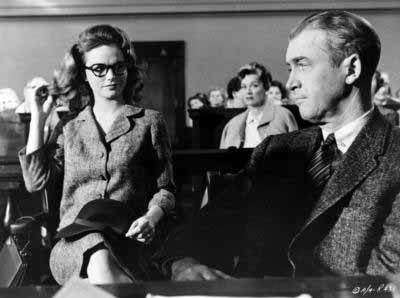
We follow up with Anatomy of a Murder (1959), in which Jimmy Stewart stars as Paul Biegler, a small-town lawyer defending Lt. Frederick Manion (Ben Gazzara), who stands accused of murdering the man who raped his wife, Laura (Lee Remick).  In the courtroom, Biegler is up against the hard-headed Asst. State Attorney General Claude Dancer (George C. Scott), a man whose character is the opposite of Biegler's.  It's a tough, complicated case.  It seems that everyone involved could just as easily be guilty as innocent.

This is a fascinating film.  First of all, it's got one hell of a cast.  All are perfectly suited to their parts.  Stewart's Biegler is still a good guy, but he's also a smart, fast-talking attorney who does what he needs to do to win his case.  It's fun to watch, and play along, as he unravels the case.  Gazzara is great in everything I've seen him in, and this is no exception.  He plays the loving husband, but subtly shows the jealous side of the character.  It's just enough to make you believe he could fly off the handle and commit the murder out of jealousy at seeing another man show interest in his wife. Remick walks the line between victim and seductress perfectly, so that when her innocence is called into question in the courtroom, you almost buy it.


Duke Ellington's Grammy award winning score is surprising and interesting.  It definitely gives the film a specific tone and helps raise the stakes in every scene.

Another thing I like about this film is how risky it was for its time.  Frank discussion of such things as rape and women's panties may be commonplace now, but it was a shock to the 1959 moviegoer.  Considering all that, plus Otto Preminger's direction, it's no surprise that this was nominated for seven Academy Awards, including Best Picture.

Saturday, June 23, 2012

Paramount Summer Classic Film Series: Chaplin in the Sound Era

Charlie Chaplin was one of the most influential directors and actors in the history of film.  While I, personally, think Buster Keaton does a better job in the physical comedy department, Chaplin is undeniably fun to watch.  I like the vaudevillian style of the Little Tramp, his signature character, and the versatility of his work.  This double feature paired The Great Dictator (1940) and Modern Times (1936).

This was the first time I had ever seen The Great Dictator, and I didn't know a whole lot about it going in.  I knew it was about WWII, and that was about it.  From Paramount film programmer Jesse Trussell's film notes, I learned that it was Hollywood's second comic portrayal of Hitler (following The Three Stooges' short You Nazty Spy earlier that year) and that Chaplin drew some inspiration for the film from Leni Riefenstahl's Nazi propaganda film, Triumph of the Will.  Some scenes in The Great Dictator are direct parodies of scenes from Triumph of the Will.  Chaplin began filming The Great Dictator in 1939, shortly after the start of WWII, after hearing about Hitler's actions from his European Jewish friends.  So there's some context.  Thanks, Jesse.

The film opens with a battle scene in which a young soldier (Chaplin) saves the life of a military pilot named Schultz (Reginald Gardiner).  Chaplin has the crowd laughing right out of the gate, with gags featuring a faulty cannon and an upside down flight.  The soldier is injured in the process and spends a great deal of time in the hospital after the war.  When he returns home to his Jewish neighborhood in Tomania, his memory of the war lost due to his injury, he discovers that the Jewish community in Tomania is suffering from persecution by the Tomanian dictator, Hynkel (also played by Chaplin).  The young soldier experiences the persecution firsthand when he tries to reopen the barber shop he left behind when he went to war.  Hynkel's followers have painted "Jew" on the windows of all businesses owned by Jewish people.  Confused, Chaplin's character begins to wash his off.  Hilarity ensues when Hynkel's soldiers catch him and try to repaint the window.  Soon after this, the Jewish community bands together to fight the persecution.  During their fight, Chaplin's character becomes close with Hannah (Paulette Goddard), a spirited young woman who came to his aid when Hynkel's soldiers attempted to arrest him for washing his window.  Schultz, remembering the young soldier who once saved his life, also eventually joins their cause, turning his back on Hynkel and his oppressive policies.

On the other side of the story is Dictator Hynkel.  As you probably guessed, Hynkel is a parody of Hitler, and Chaplin portrays his as a childish ruler who speaks in gibberish a lot of the time.  When Hynkel learns that Schultz has joined forces with the Jews, he has him arrested.  He also sends soldiers to capture all the Jews and put them in concentration camps.  Schultz and the Barber manage to escape. Hynkel doesn't seem to notice because he is busy planning an attack on a neighboring country.  The young Barber is mistaken for Hynkel and brought up to speak before a crowd of Hynkel's followers and all the citizens of Tomania, who are eagerly listening on the radio.  The listeners include Hannah and her family, who were forced to flee when Hynkel's soldiers came after all the Jewish people.

The ending speech is moving.  At the time, it served to remind audiences of the grave circumstances going on around them.  World War II was raging.  Hundreds of thousands of people died.  Unbelievable atrocities against humanity were being committed.  It probably felt as though the world was going to hell in a hand basket.  This was meant to call attention to those things, and to inspire people to stand against them.   And it remains relevant even now, 72 years later.


This film is fantastic.  It's funny.  It's inspiring.  It's fascinating to watch Charlie Chaplin play two extremely different characters.

Next, we moved on to Modern Times.


This is probably my favorite Chaplin movie.  Even though it is part of the sound era, it has no dialogue.  Chaplin intended it to be his first talkie, but experiments showed that audiences would not react well to hearing The Tramp speak.  This was The Tramp's last appearance.  Chaplin used this film to critique American life during the Great Depression, specifically poor (and sometimes downright inhumane) working conditions.  Again, thanks to Jesse Trussell for the context.  

In this one, The Tramp is a factory worker who is fired from his job following a nervous breakdown caused by the working conditions in the factory.  He gets treatment for his breakdown and sets off to return to work when he accidentally ends up at the front of a Communist demonstration march.  He is arrested and sent to jail.  During his misadventures, he meets the Gamin (Paulette Goddard), an orphan girl living on the streets near the town port.  She has stolen a loaf of bread, and the police are chasing her.  He helps her escape arrest, but ends up in jail.  They quickly fall in love, and after his release from jail, she sets about finding them a house and he goes in search of a job.  He eventually goes back to work at the factory he worked at when the film began, and she finds a job as a performer in a night club.  After another series of mishaps, The Tramp is fired from the factory, and the Gamin helps him get a job as a waiter in the night club where she works.  As it turns out, he is a terrible waiter, but a good singer, so their boss tells him to perform instead.  The police, who have been pursuing the Gamin since she escaped arrest, track them down at the night club and come after her.  The Tramp and the Gamin flee, and set off in search of a new home in a new town.

This film contains some of my favorite Chaplin gags, including the trapped-in-the-gears bit.  I never cease to be impressed by what they were able to accomplish without the special effects technology that is available now.  The upside down flight in the Great Dictator is a great one too.  Modern Times is also interesting in that it's a sound film without dialogue.  It does use sound effects though.  Machinated voices are heard barking orders in the factory where The Tramp works, and there is a very Big Brother-ish scene in which the boss' face appears on a screen in the men's room telling the workers taking their time in there to get back to work.  The sound effects are mostly used to help make the point about the harshness of working conditions at the time.

This is a great pair of films, and I'm glad I got the chance to see them on the big screen.  If you haven't seen them, I recommend that you do so. They are both available for streaming on Hulu Plus.

Up next: A double helping of Jimmy Stewart featuring Harvey and Anatomy of a Murder.

Movies: God Bless America

So, I have been particularly busy this month, and thus haven't had time to write posts about several things I have gone to see.  But, I have just begun a three day weekend, and I have decided to add catching up on the blog to my list of projects for this short time off.  Starting with Bobcat Goldthwait's God Bless America.


Have you ever wanted to punch someone in the face for being obnoxious, rude, or just downright stupid?  If so, you will probably like this movie.  Frank (Joel Murray) is surrounded by idiots.  His neighbors are unbelievably inconsiderate.  His coworkers are incapable of holding a conversation about anything other than the latest celebrity gossip.    When he turns on the television, all he sees is more stupidity and cruelty.  Usually, Frank deals with that by fantasizing about killing all the terrible people in his life.  When he learns that he is dying of cancer, he just can't take it anymore. So, he goes out and actually kills someone.  His first victim is Chloe, a high school student from a reality TV show akin to My Super Sweet Sixteen, or any show that features spoiled rich kids who have done absolutely nothing to deserve that sort of attention.  Frank shows up to Chloe's school, and shoots her, point blank.  Frank originally intended to stop there, and kill himself before getting caught.  However, Roxy (Tara Lynne Barr), another student at Chloe's school, witnesses the shooting, and convinces Frank to keep up the good work, and to let her tag along.  Together, they set out to make the world, or at least the country, a better place, by ridding it of it's most abhorrent citizens.

Thinking back, it occurs to me that this movie requires a pretty significant suspension of disbelief.  It's pretty unlikely that a middle aged man and a teenage girl going around shooting people point blank in broad daylight would go very long without getting caught.  That said, I really enjoyed this for a couple of reasons.  For one thing, it's lighthearted and funny; a good time at the movies.  Underneath that, it's pointing out a lot of the things that are wrong with today's society.  It takes shots at everything from the triviality of the things that the general population is concerned with to the lengths some people are willing to go to for their fifteen minutes of fame to the horrendous ways some people/groups are treated.  At the beginning of the film, Frank eloquently explains his frustrations to a coworker in a monologue that includes the question, "Why do we have a civilization if we're no longer interested in being civilized?"  Watching all the people Frank encounters on a daily basis, coupled with that monologue made me even more grateful for the people I have in my life.  I understand that a lot of those characters are probably exaggerated for comic effect, but even so, I am glad that I have managed to surround myself with people who are not even a little bit like that.  All of my friends are thoughtful, intelligent people who read for pleasure, enjoy a challenge, and are willing to work hard at the things they are passionate about.  They inspire and challenge me, and I am a better person for knowing them.  I am a lucky girl.

Coming up: lots of posts about the Paramount's Summer Classic Film Series.  I have gotten to attend several double features in the last couple of weeks.  While I have fallen hopelessly behind on my Netflix queue project, I just can't pass up the opportunity to catch these movies on the big screen.


Sunday, June 10, 2012

Operation: Conquer the Netflix Queue: Brokeback Mountain

As I remember, this movie got a lot of attention when it came out, back in 2005, for being "the gay cowboy movie."  It's more than that, though.  It's a story about love of the purest kind; not only does it survive time, distance, lack of acceptance, and even the mens' own fears about their feelings.


Jack Twist (Jake Gyllenhaal) and Ennis Del Mar (Heath Ledger), meet in the summer of 1963, when they, by chance, both show up to look for work as shepherds on Brokeback Mountain in Wyoming.  They are both hired, and spend the summer together atop the mountain, where their affair begins.  Even though I knew the story, that part still caught me by surprise.  Leading up to it, they don't speak to each other much, mostly because Ennis is a man of very few words.  And, it isn't clear that they are attracted to each other at first.  So, when, after a few days and a few shots of whiskey, they have sex, it's a little surprising.  The scene is completely unromantic.  There is no soft lighting or background music.  It actually borders on violent.  Afterwards, Ennis tells Jack that he "ain't no queer," and that it's a "one shot thing."  Jack agrees.  But it's not.  The summer ends, and both boys go back to their lives, Ennis in Wyoming and Jack in Texas.  Years pass, both get married and have children.  But sometimes, Jack visits Ennis in Wyoming, and the two go on "fishing trips."

On one of these visits, Ennis' wife Alma (Michelle Williams), catches Ennis and Jack kissing.  She doesn't say anything, but she does notice that Ennis never brings home any fish.  From there, it's not hard for her to put two and two together, but she shoulders the burden of knowing that her husband is not in love with her, but with another man silently for a long time.  Eventually, Ennis and Alma get a divorce.  She still hasn't said that she know about Ennis and Jack, but Ennis probably knows.  Williams' performance in this role is excellent.  She particularly stands out in a couple of scenes.  In one, Ennis is leaving on one of his "fishing trips," but he's left his tackle box behind.  "Hey, aren't you forgetting something?" she asks.  He comes back in, gives her a kiss, and leaves.  Without picking up the tackle box.  By this point, she already knows about Ennis and Jack, and this is just further confirmation for her.  In the moment that the camera lingers on her, I could feel that knowledge weighing on her and imagine how much it must hurt.  The other is a scene in which she finally tells Ennis that she knows he wasn't fishing with Jack.  They are already divorced, and she is remarried, but Ennis has come over to have Thanksgiving dinner with her and his daughters.  While they are alone in the kitchen, Alma tells Ennis that she once left him a note in his tackle box: "Please bring home some fish."  After Ennis returned home, without any fish, she saw that the note was untouched.  In one of his most expressive moments in the film, Ennis angrily grabs her by the arm.  She is frightened, and yells at him to leave.  It is clear that, though she has moved on since the divorce, she must have truly loved Ennis, maybe she still does, and that his betrayal of their marriage still hurts her.

That scene is a big one for Ennis too, as it's one of the only times we get to see him be really emotional.  If the movie didn't focus so closely on Ennis and Jack, we might not get to know Ennis at all, he is so guarded.  Ledger shows that in every facet of Ennis.  It shows in the way Ennis carries himself throughout the movie, in the way he speaks, and in what he says.  Physically, he always seems to be pulling into himself.  He doesn't say much, and when he does speak, it's through almost closed lips.  There are only a few scenes in which he lets his guard down, and most of those happen when no other characters are present.  In one though, he reveals something to Jack that tells us as the audience a lot about why he is the way he is.  He tells Jack that when he was just a kid, there were two men in town who were living together.  One day, those two men were found beaten to death, and Ennis' father made sure that he and his brother saw the bodies.  "Hell,"  he says, "for all I know, he {Ennis' father} did it." So, from a very young age, he was taught to believe that the way he felt was wrong.  That he wasn't supposed to be the way he was.  It's a pivotal moment, not just because it helps the audience understand Ennis as a character, but also because he is doing something uncharacteristic by sharing it.  There is a scene at the end of the movie, after Jack has died, in which Ennis breaks down while going through Jack's room during a visit to his parents.  He actually cries.  It's unexpected from a man who for most of the film goes out of his way to hide his feelings.

Jack accepts himself more readily than Ennis, which is most likely why he is always the one going out of his way to visit Ennis, making a greater effort to keep their relationship alive.  Ennis is terrified of being found out, while Jack seems much less concerned about it.  That fact made his character arc a little less interesting, for me at least, because he didn't seem to have the same inner conflict that Ennis had.  He's likable, and it's heartbreaking when he dies, but at least some of that comes from Ennis' reaction to it.  That is also the scene that stood out most to me for Lureen (Anne Hathaway), Jack's wife.  Ennis calls her to find out what happened to Jack, and as she tells Ennis about how Jack was trying to change a tire and it exploded, causing the hubcap to fly into his face, breaking his nose and leaving him lying unconscious in a pool of his own blood.  By the time he was found, it was too late.  During the story, we see Jack getting beaten to death with a tire iron, just like the two men from Ennis' youth.  I couldn't help but wonder, was that what really happened, or is that Ennis' imagination.  The scene stood out for Lureen's character for me because it was the first time I wondered whether she knew, or at least suspected, anything about the relationship between Jack and Ennis.

I really like character driven stuff like this, which I suppose is why I had so much to say about it.  More than I thought I would.  As far as I'm concerned, all the special effects in the world can't hold a candle to really great characters portrayed by really solid actors.  Explosions and car chases and whatnot can be fun, but if you have engaging characters and a good story, you don't need all those bells and whistles.  I really appreciated that about this film.  That and the underlying message about love and acceptance.  Sometimes, I just need to see something that reminds me that true love can survive anything, even when it's far from perfect or comes from an unexpected place.  The fact that this happens to involve a gay couple brings to mind everything that has been in the news recently about gay rights.  Granted, that has been overshadowed by the "zombie attack" stories, but it's still an important issue.  This story starts in 1963, and homosexuality was harshly persecuted at that time.  As a society, I think we like to think we've come a long way since then, but, in this particular issue, I'm not so sure that we have.  And that is devastating to me.  It isn't anyone's place to judge another person for who they fall in love with.  We should be celebrating the fact that they were able to find love at all.  Or at least letting them celebrate it.

But I digress.  And knowing the people who are most likely to be reading this, I expect I'm just preaching to the choir anyway.  Next on the list is a very long movie about Mozart.


Tuesday, May 29, 2012

Paramount Summer Classic Film Series: Killer of Sheep

The best thing about summer in Austin is the annual Summer Classic Film Series at the Paramount Theater.  Just about everyday, they're showing double features of great classic films.  It's a chance to get out of the heat and watch a couple of movies you wouldn't otherwise get to see on the big screen.  All for less than the price of a regular movie ticket.  Tonight's double feature consisted of John Cassavetes' Shadows and Charles Burnett's Killer of Sheep.  I missed Shadows, unfortunately, but I did get to see Killer of Sheep.  

It follows Stan (Henry Gayle Sanders) and his wife, played by Kaycee Moore in their daily lives.  He works at a slaughterhouse, then comes home to help her fix up the house and raise the kids.  It's an interesting film in a lot of ways.  Not the least of which is that there isn't a straightforward plot line.  In a series of seemingly unconnected scenes, Stan goes to work, comes home, sees his friends, tries to go to a race on which he has placed a bet (his friend gets a flat tire and they don't make it).  The kids go to school, play, get bullied, witness a theft.  But nothing really happens; it doesn't go anywhere.  And yet, a lot of things have happened.  Lessons have been learned and decisions made that will potentially have an effect on the family's lives that they can't even fathom yet.  So, we as viewers can't either.  It just looks like any other day.

Because the scenes are edited that way, it also feels a lot like a documentary, even though it's not.  In some ways, it reminded me of Yakuaya, the silent documentary I saw at Cine Las Americas this year.  The scenes in the slaughterhouse were particularly reminiscent of that film for me.  Other scenes felt like Frederick Wiseman's High School.  Only, you know, less Wisemany.  I think it felt that way because Wiseman's style was to observe without commenting, which is pretty much what was going on here.  I read that the scenes in which the children are playing were completely unscripted, so it makes sense that they would have a documentary-type feel to them.  It's interesting to see what kids will do to entertain themselves.  These kids didn't have a lot of toys, so they played with things they found lying around: rocks, Halloween masks, whatever.  

I think my favorite thing about it, though, was the music.  And not just because it primarily consisted of jazz and blues music, which I happen to like a lot.  I've always appreciated how powerful music can be.  it can make a bad day into a good one, help purge negative feelings, make a mundane task fun.  In this film, it added grace and beauty to otherwise grotesque slaughterhouse scenes, brought out the romance in the relationship between Stan and his wife, and added a sense of calm to a scene in which a child is injured while playing.  It's absence had an impact too.  We expect a film to have a score, something playing in the background to help set the tone of each scene.  So when it's not there, the scene is automatically a little less comfortable, a little harder to watch.  You might not even be able to put your finger on why that is right away, but it makes a big difference.  In this case, it feels a little less like you're watching things happen in a movie and a little more like you're watching in real life, peeking around a corner to see what's going on over there.  You almost feel guilty for not helping that kid who's getting picked on, until you remember that it's just a movie.  

I enjoyed it.  I don't think a lot of people would though.  It's not anything like the movies you'd see in theaters now.  It doesn't seem to be trying to be entertaining.  It's more of a realistic look at a part of American culture that those of us who haven't lived that way, in that time, wouldn't otherwise know anything about.  I think it's fascinating.  I'm glad I managed to get out and see it.  I hope I'll get to a lot the Classic Film Series.  This year's line up is really great.  Check it out.